Acupuncture After Joint Replacement Surgery: Supporting Pain Relief, Healing, and Recovery

Dr. Tatyana's Health and Wellness Blog
Treating the whole person to restore optimal health. Check back often for up-to-date news and information about acupunture and Chinese medicine.




Search All Blog Posts
Blog Post Archive Categories
- Acupuncture After Joint Replacement Surgery: Supporting Pain Relief, Healing, and Recovery
- How a High-Stress Job Can Weaken Your Immune System and Disrupt Your Body`s Natural Balance
- ADHD and Acupuncture: A Natural Approach to Supporting Focus, Calmness, and Emotional Balance
- Stubborn Weight Retention After Menopause: Why It's So Common - and How Acupuncture Can Help
- Chronic Stress and Burnout: How Acupuncture Can Help You Restore Balance
- Stubborn Neck Pain: How Acupuncture Can Help You Find Lasting Relief
- Chronic Fatigue and Chronic Inflammation: A Holistic Look Through Western and Eastern
- The Hidden Dangers of Overusing Supplements: Are You Taking More Than You Should?
- The Importance of Exercise and How to Stay Motivated for a Healthier You
- Surgical Tissue Injury and Inflammation
During surgery, tissue injury activates the body’s inflammatory response. Immune cells release signaling molecules such as prostaglandins, interleukins, and tumor necrosis factor-alpha (TNF-α). These mediators help coordinate tissue repair but can also increase the sensitivity of pain receptors, known as nociceptors. This process, called peripheral sensitization, contributes to tenderness and pain during the early postoperative period. Inflammation is necessary for normal healing; the goal is to manage excessive pain and restore function safely. - Changes in Pain Processing
After surgery, repeated pain signals travel from the operated joint through peripheral nerves to the spinal cord and brain. In some patients, persistent nociceptive input may increase the excitability of neurons within the central nervous system. This phenomenon, known as central sensitization, can contribute to heightened pain sensitivity and persistent postoperative pain. - Muscle Weakness and Protective Guarding
After joint replacement, surrounding muscles may become inhibited or tense in response to pain, swelling, and altered joint mechanics. Quadriceps weakness following total knee arthroplasty is a major rehabilitation challenge and can interfere with walking, stair climbing, and functional recovery. - Postoperative Swelling and Reduced Mobility
Tissue trauma increases local vascular permeability, allowing fluid to accumulate in surrounding tissues. Swelling can restrict movement, increase discomfort, and make rehabilitation exercises more difficult. Sudden or worsening swelling, especially with calf pain, redness, or shortness of breath, requires urgent medical assessment for possible complications such as blood clots. - Activation of the Body’s Natural Pain-Modulating Systems
One proposed mechanism involves endogenous opioids, including beta-endorphins, enkephalins, and dynorphins. These naturally occurring substances participate in pain regulation by interacting with opioid receptors. Acupuncture stimulation may activate sensory nerve pathways that influence their release and activity, potentially contributing to pain relief without adding an opioid medication. - Modulation of Spinal Cord Pain Transmission
Pain signals from the operated joint enter the spinal cord through sensory nerve pathways. Experimental studies suggest that acupuncture can influence how these signals are processed within the spinal dorsal horn, possibly through neurotransmitter changes and inhibitory pain pathways. - Activation of Descending Pain-Inhibitory Pathways
The brain has mechanisms for suppressing pain. The periaqueductal gray, rostral ventromedial medulla, and related brainstem networks participate in descending pain modulation, using neurotransmitters such as serotonin and norepinephrine. Acupuncture may influence these systems, although precise mechanisms and clinical importance remain under investigation. - Possible Effects on Inflammatory Signaling
Preclinical research suggests that acupuncture may influence inflammatory mediators, including certain cytokines and prostaglandin-related pathways. Researchers are also studying sensory nerve, autonomic, and immune interactions. Laboratory findings do not establish that acupuncture accelerates wound healing or prevents postoperative complications in humans. Clinical evidence primarily concerns pain relief, analgesic use, and short-term function. - Reducing Postoperative Pain
Pain control is central to rehabilitation. Severe pain can discourage walking, joint bending, and physical therapy. Acupuncture may help some patients experience less pain at rest or during movement, making prescribed activities easier to tolerate. - Potentially Reducing the Need for Opioid Pain Medication
Opioids can provide important postoperative relief but may cause nausea, constipation, sedation, and dizziness. Some trials suggest acupuncture can reduce opioid requirements in multimodal care. A randomized trial involving 60 knee replacement patients reported lower fentanyl consumption in the acupuncture group. Results remain mixed; patients must not independently reduce prescribed medication. - Supporting Range of Motion and Rehabilitation
Regaining knee flexion and extension is essential after total knee replacement. A 2024 meta-analysis reported improvements in active range of motion during early recovery, especially around postoperative day seven and week two. Acupuncture cannot replace strengthening, gait training, stretching, or prescribed rehabilitation. - Helping Manage Muscle Tension and Compensatory Pain
Protective movement patterns after surgery can increase stress on the hip, lower back, or opposite leg. Acupuncture may be considered for certain associated musculoskeletal pain conditions and improve comfort during rehabilitation. - Supporting Sleep and Emotional Well-Being
Pain, limited mobility, medications, and anxiety can disrupt sleep. Some patients find acupuncture relaxing and report better subjective sleep. Evidence specifically for postoperative sleep after joint replacement remains inconclusive. - Whether the incision is healing appropriately
- Signs of infection or other complications
- Use of anticoagulant medication
- Whether swelling is stable or worsening
- Whether the surgeon has cleared complementary treatment
- Individualized acupuncture to address discomfort and associated musculoskeletal symptoms.
- Distal acupuncture techniques when local needling is inappropriate.
- Gentle treatment for compensatory muscle tension.
- Cold laser (low-level light) therapy may be considered for selected concerns, although joint-replacement evidence is limited and device-specific.
- Lifestyle and recovery guidance reinforcing rehabilitation, nutrition, sleep, and safe activity progression.
Acupuncture After Joint Replacement Surgery: Supporting Pain Relief, Healing, and Recovery
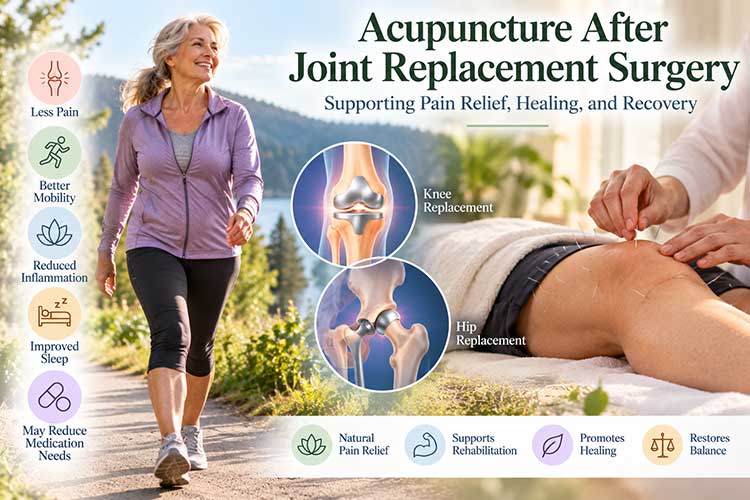
How acupuncture may help manage postoperative pain, reduce medication requirements, and support rehabilitation after knee, hip, and other joint replacement procedures.
Joint replacement surgery can be life-changing. For patients suffering from advanced osteoarthritis, severe joint degeneration, or chronic pain, surgery often provides an opportunity to regain mobility and improve quality of life.
However, successful surgery is only the beginning of recovery.
Following a total knee replacement, hip replacement, or other orthopedic procedure, patients may experience pain, swelling, stiffness, muscle weakness, sleep disturbances, and difficulty returning to normal activities.
Although physical therapy, appropriate medication, and rehabilitation remain essential, many patients are interested in additional nonpharmacological approaches to improve comfort during recovery.
Acupuncture is increasingly being studied as a complementary treatment for postoperative pain management. Emerging evidence suggests that it may help reduce pain and opioid consumption in certain surgical patients, although results vary and the quality of evidence is not uniform.
At Family Acupuncture and Health in Kirkland, Washington, Dr. Tatyana combines her background in medicine with advanced training in acupuncture and pain management to provide individualized supportive care for patients recovering from orthopedic surgery.
Why Pain and Stiffness Persist After Joint Replacement Surgery
Joint replacement involves more than replacing damaged cartilage and bone surfaces. It also affects surrounding muscles, connective tissues, blood vessels, and sensory nerves. Even when surgery is technically successful, the body must recover from controlled surgical trauma.
How Acupuncture May Influence Postoperative Pain: The Science
Acupuncture involves stimulating specific anatomical locations using thin, sterile, single-use needles. Its effects on pain are being investigated through several neurophysiological mechanisms involving peripheral sensory nerves, the spinal cord, and pain-processing regions of the brain.
What Does Scientific Research Show About Acupuncture After Joint Replacement?
Several systematic reviews and randomized controlled trials have investigated acupuncture following total knee arthroplasty.
2024 Systematic Review — The Journal of Pain
A meta-analysis of 23 studies involving 1,464 patients found improvements in short-term pain outcomes and active knee range of motion after knee replacement. Benefits were most evident in the first two postoperative weeks. Study heterogeneity and risk of bias limited certainty.
2017 Systematic Review — JAMA Surgery
An analysis of 39 trials involving 2,391 patients across nonpharmacological interventions found moderate-certainty evidence that acupuncture and electrotherapy could reduce or delay opioid consumption after knee replacement. Evidence for pain reduction was less certain.
2026 Systematic Review — Electroacupuncture
A meta-analysis of 16 trials involving 1,142 patients reported reductions in pain at rest and during movement in the first postoperative week after total knee replacement. Questions remain about optimal protocols, study quality, and safety.
These studies suggest acupuncture may be useful as an addition to postoperative pain management, not a replacement for medication, physical therapy, or orthopedic follow-up. Research is strongest for total knee replacement; evidence for hip, shoulder, and other joint replacements is more limited.
Potential Benefits of Acupuncture During Postoperative Recovery
When Is It Safe to Begin Acupuncture After Joint Replacement?
Timing matters. Some hospital studies begin acupuncture within days of surgery under medical oversight. Outpatient timing depends on the patient’s condition and the orthopedic surgeon’s recommendations.
Do not needle through or near an unhealed incision, infected tissue, or a restricted area. Anticoagulants can increase bruising or bleeding risk. A prosthesis does not automatically prohibit distal acupuncture, but infection prevention is especially important.
Deep needling near a prosthetic joint should be avoided without appropriate expertise and surgical clearance.
A Comprehensive Approach at Family Acupuncture and Health
Dr. Tatyana considers surgical history, symptoms, functional limitations, and overall health, with treatment adapted to recovery stage and surgical precautions.
Why a Series of Treatments May Be Helpful
Recovery unfolds over weeks and months. Acupuncture is often delivered over several sessions, adjusted to symptoms and response. Some people notice improvement after one session; others need several to assess benefit. Progress should be measured using pain, sleep, physical therapy participation, and function. There is no universally established acupuncture schedule for joint replacement recovery; continuing care should depend on meaningful improvement.
Acupuncture and Physical Therapy: Working Together
Physical therapy restores mobility, strength, balance, gait mechanics, and independence. Acupuncture primarily offers a possible complementary approach to pain management. When coordinated, they may support more comfortable rehabilitation, but pain relief must be paired with safe functional movement and protection of healing tissues.
Why Choose Dr. Tatyana for Postoperative Support?
At Family Acupuncture and Health in Kirkland, Washington, Dr. Tatyana combines medical knowledge, acupuncture training, and experience in musculoskeletal pain. Her goal is to support recovery by addressing pain, tension, sleep disturbance, and related discomfort while following orthopedic precautions.
Supporting a More Comfortable Recovery
Joint replacement surgery can significantly improve mobility and quality of life, but recovery can be challenging. Research suggests acupuncture may reduce postoperative pain, potentially decrease analgesic requirements, and improve certain short-term outcomes, particularly after total knee replacement. More high-quality research is needed.
If you are recovering from knee or hip replacement and want additional pain-management support, contact Family Acupuncture and Health in Kirkland, Washington, to discuss whether acupuncture is appropriate for your stage of recovery.
Medical disclaimer: Acupuncture is complementary and does not replace orthopedic care, medication, or physical therapy. Obtain surgeon clearance. Fever, wound drainage, increasing redness, sudden severe pain, or suspected blood clots require prompt medical evaluation.
Scientific References
1. Acupuncture Provides Short-Term Functional Improvements and Pain Relief for Patients After Knee Replacement Surgery. The Journal of Pain (2024). https://doi.org/10.1016/j.jpain.2024.104669
2. The Role of Acupuncture in Postoperative Pain Management of Patients Undergoing Knee Arthroplasty Surgery. Systematic review (2021). https://pubmed.ncbi.nlm.nih.gov/34415872/
3. Effects of Acupuncture on Postoperative Pain After Total Knee Replacement. Pain Medicine (2021). https://pubmed.ncbi.nlm.nih.gov/34152398/
4. Efficacy and Safety of Electroacupuncture for Pain Alleviation in Post-Total Knee Arthroplasty Patients. Systematic review (2026). https://pubmed.ncbi.nlm.nih.gov/41656711/
5. NCCIH. Acupuncture: Effectiveness and Safety. https://www.nccih.nih.gov/health/acupuncture-effectiveness-and-safety