Understanding Acupuncture: Why One Treatment Is Often Not Enough and How Its Cumulative Effects Work

Dr. Tatyana's Health and Wellness Blog
Treating the whole person to restore optimal health. Check back often for up-to-date news and information about acupunture and Chinese medicine.
Most Recent Posts ...




Search All Blog Posts
Blog Post Archive Categories
- Acupuncture After Joint Replacement Surgery: Supporting Pain Relief, Healing, and Recovery
- How a High-Stress Job Can Weaken Your Immune System and Disrupt Your Body`s Natural Balance
- ADHD and Acupuncture: A Natural Approach to Supporting Focus, Calmness, and Emotional Balance
- Understanding Acupuncture: Why One Treatment Is Often Not Enough and How Its Cumulative Effects Work
- Stubborn Weight Retention After Menopause: Why It's So Common - and How Acupuncture Can Help
- Chronic Stress and Burnout: How Acupuncture Can Help You Restore Balance
- Chronic Fatigue and Chronic Inflammation: A Holistic Look Through Western and Eastern
- The Hidden Dangers of Overusing Supplements: Are You Taking More Than You Should?
- The Importance of Exercise and How to Stay Motivated for a Healthier You
- Acupuncture Activates Sensory Nerve Pathways
Needle stimulation can activate mechanosensitive receptors and sensory nerve fibers, including A-delta and C fibers. These fibers transmit sensory information to the central nervous system. The resulting neural activity may influence spinal cord processing and engage pathways involved in pain modulation. This is one reason acupuncture can have effects beyond the immediate location of needle insertion. - Acupuncture May Stimulate Endogenous Pain-Relieving Mechanisms
Your body produces natural substances that help regulate pain. These include endogenous opioids such as beta-endorphins, enkephalins, and dynorphins. Experimental research suggests that acupuncture and electroacupuncture can influence these systems. Acupuncture may also affect neurotransmitters such as serotonin and norepinephrine, which participate in descending pain-inhibitory pathways. These processes may contribute to analgesia, although they do not fully explain acupuncture’s clinical effects. - Acupuncture Can Influence Pain Processing in the Brain
Pain is not simply a signal coming from an injured body part. It is a complex experience shaped by sensory input, emotional state, previous experiences, and activity within multiple brain networks. Research using functional magnetic resonance imaging (fMRI) has explored how acupuncture affects brain regions involved in pain processing, attention, and emotional regulation. Some studies have reported changes in functional connectivity and brain activity following acupuncture. However, these findings vary across studies and do not establish a single universal mechanism. - Acupuncture May Influence Autonomic Nervous System Activity
The autonomic nervous system helps regulate functions such as heart rate, digestion, and the body’s response to stress. It consists of sympathetic and parasympathetic divisions. Experimental studies suggest that acupuncture can influence autonomic reflexes, including certain vagal and sympathetic pathways. These effects depend on stimulation parameters and anatomical location. This may help explain why some patients experience relaxation during treatment, although claims that acupuncture consistently “resets” the nervous system are not scientifically established. - Assess the patient’s initial response to acupuncture.
- Monitor changes in pain intensity and frequency.
- Evaluate whether improvements last longer between appointments.
- Adjust acupuncture points and techniques based on clinical findings.
- Support participation in appropriate exercise, rehabilitation, and other recommended treatments.
Understanding Acupuncture: Why One Treatment Is Often Not Enough and How Its Cumulative Effects Work
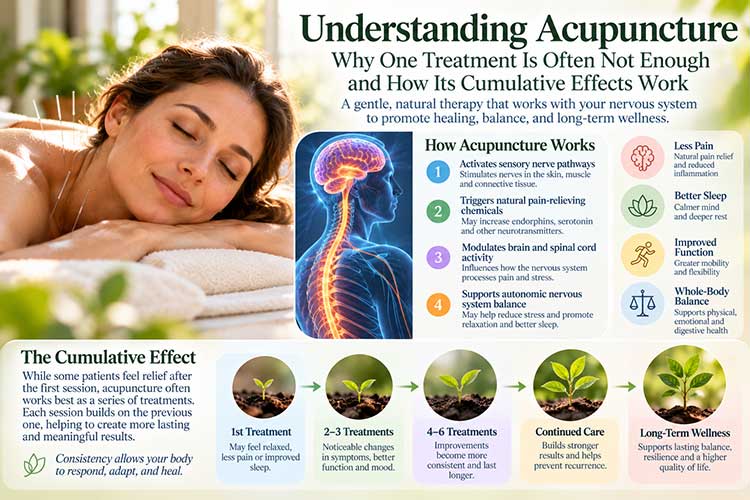
The science behind acupuncture, nervous system regulation, pain relief, and why a consistent series of treatments may produce more lasting benefits.
Have you ever wondered why your acupuncturist recommends a series of treatments instead of just one appointment?
Many patients experience noticeable relaxation, reduced pain, or improved sleep after their first acupuncture session. Others may notice only subtle changes initially, with improvements becoming more apparent over several visits.
Why does acupuncture often work best when treatments are repeated consistently? The answer involves the nervous system, pain-processing pathways, neuroplasticity, and the body’s complex physiological responses to therapeutic stimulation.
Acupuncture is not simply about inserting needles into painful areas. It is a form of sensory stimulation that can influence how the peripheral nervous system, spinal cord, and brain process information.
At Family Acupuncture and Health in Kirkland, Washington, Dr. Tatyana emphasizes individualized treatment plans and patient education. Understanding why acupuncture is often recommended as a series can help patients establish realistic expectations and make informed decisions about their care.
What Actually Happens in Your Body During Acupuncture?
Acupuncture involves inserting extremely thin, sterile needles into carefully selected points on the body. From a traditional Chinese medicine perspective, acupuncture is used to regulate the flow of Qi, address patterns of imbalance, and support the body’s natural capacity for self-regulation.
Modern biomedical research examines acupuncture through neurophysiology, connective tissue biology, and pain science. When an acupuncture needle stimulates the skin, muscle, or connective tissue, it can activate several types of sensory nerve fibers. These signals travel through peripheral nerves toward the spinal cord and brain, where they may influence pain perception and other physiological processes.
The effects depend on multiple factors, including needle location, stimulation technique, treatment duration, and the patient’s underlying condition.
Why Acupuncture Has a Cumulative Effect
One of the most important concepts patients should understand is that acupuncture is often more beneficial when delivered as a planned series rather than as an isolated treatment. The term cumulative effect describes a pattern in which clinical improvements may develop over repeated sessions.
For example, a patient with chronic neck pain may experience several hours of relief after the first treatment. Following additional sessions, the patient may notice that pain episodes become less frequent, discomfort becomes less intense, or relief lasts longer. Not every patient experiences this progression, but it is one reason clinicians commonly recommend evaluating acupuncture over several visits.
The Role of Neuroplasticity
Neuroplasticity refers to the nervous system’s ability to modify its activity and connections in response to experience and stimulation. Chronic pain can involve changes in how the brain and spinal cord process sensory information. Over time, pain-related pathways may become more sensitive, making ordinary movement or stimulation feel uncomfortable.
Repeated therapeutic sensory stimulation, including acupuncture, is being investigated for its potential to influence these processes. Researchers hypothesize that repeated acupuncture may help modify activity in pain-processing networks and descending pain-inhibitory pathways. However, the precise relationship between repeated acupuncture sessions and lasting neuroplastic changes in humans has not been fully established.
Repeated Stimulation and Pain Modulation
A single acupuncture session can produce short-term physiological responses. With repeated treatments, patients may experience a more sustained improvement in symptoms. Several mechanisms could contribute, including changes in pain sensitivity, reduced muscle guarding, improvements in movement, and changes in the patient’s response to pain.
These effects should not be interpreted as proof that each acupuncture session produces a fixed or predictable increase in healing. Rather, repeated treatments allow clinicians to assess whether benefits are developing and lasting.
What Does Scientific Research Say About Long-Term Acupuncture Benefits
Scientific evidence supports the use of acupuncture for several chronic pain conditions, particularly chronic musculoskeletal pain, knee osteoarthritis, and certain headache disorders.
A major individual patient data meta-analysis published in The Journal of Pain evaluated 39 randomized controlled trials involving 20,827 patients. Researchers found that acupuncture provided greater pain relief than both sham acupuncture and no acupuncture treatment, although the differences were smaller when compared with sham procedures. Importantly, the analysis found that treatment benefits often persisted after the course of acupuncture had ended.
A separate meta-analysis examined how long acupuncture’s effects lasted after treatment. It included 29 clinical trials involving 17,922 patients with chronic pain; longer-term follow-up was available from 20 trials involving 6,376 participants.
The results suggested that much of the benefit from a course of acupuncture for chronic pain could persist for up to 12 months, although the amount of benefit depended on the comparison group and condition being treated.
These findings support the clinical value of a treatment course, but they do not prove that every additional session creates an accumulating biological effect or that more sessions are always better.
Why One Acupuncture Treatment May Not Be Enough
Consider a patient who has experienced chronic lower back pain for five years. During that time, the patient may have developed muscle guarding, reduced mobility, altered movement patterns, and increased sensitivity to pain. One acupuncture session may provide temporary relief, but it is unlikely to resolve every factor contributing to the condition.
A structured treatment series offers an opportunity to:
The goal is not simply to provide temporary symptom relief, but to determine whether acupuncture contributes to meaningful improvements in daily function and quality of life.
How Many Acupuncture Treatments Do You Need?
There is no single treatment schedule that works for everyone. The appropriate frequency and duration depend on the patient’s diagnosis, symptom severity, medical history, and response to treatment. For chronic pain conditions, a reasonable initial clinical approach may involve one or two appointments per week, followed by reassessment.
An Example of a Personalized Treatment Plan
Initial phase — Weeks 1–2: Begin treatment and observe early changes in pain, muscle tension, sleep, and daily activities.
Evaluation phase — Weeks 3–4: Assess whether improvements are becoming more consistent or lasting longer between visits. Adjust treatment if needed.
Continuation phase — Weeks 5–6: Continue when meaningful progress is occurring, or reconsider the approach if improvement is insufficient.
Follow-up and maintenance: Gradually reduce appointment frequency when appropriate. Maintenance visits are individualized and are not necessary for every patient.
This is an illustrative schedule, not a scientifically established protocol for every condition. Some patients respond relatively quickly. Others may require a longer treatment period, and some may not experience meaningful improvement. A good acupuncture treatment plan should always include regular reassessment—not simply a predetermined number of appointments.
Why Consistency Matters
Patients sometimes schedule one acupuncture appointment, experience relief, and then wait several months before returning. For certain conditions, a single session may be sufficient to meet the patient’s immediate goals. However, when treating persistent symptoms, inconsistent appointments may make it difficult to evaluate whether a structured course would provide additional benefit.
Regular appointments during the initial treatment period can help establish a consistent treatment exposure and allow the practitioner to track the patient’s response. Consistency does not mean receiving acupuncture indefinitely. The objective is to identify the smallest reasonable number of treatments needed to achieve a meaningful benefit.
What Should Patients Expect During a Series of Acupuncture Treatments?
Every patient’s experience is different. Some notice relaxation immediately after treatment. Others report gradual changes over several sessions. For chronic pain, signs of meaningful improvement may include reduced pain intensity, fewer flare-ups, improved mobility, better tolerance of exercise, or less interference with sleep and everyday activities.
For example, a patient with chronic knee pain might initially report pain at a level of 7 out of 10. After several appointments, that patient may report pain at 4 out of 10 and improved ability to walk or climb stairs. This is an illustrative example rather than a guaranteed treatment outcome.
Patients should also understand that acupuncture does not necessarily eliminate the underlying cause of a condition. Structural problems, inflammatory diseases, and neurological disorders may require additional medical management.
Does Acupuncture Work Only for Pain?
Acupuncture is used for many health concerns, including headaches, sleep disturbances, stress-related symptoms, nausea, and certain musculoskeletal conditions. However, the scientific evidence differs considerably between conditions. The strongest evidence for lasting benefits comes from research on specific chronic pain disorders.
For insomnia, anxiety, fatigue, and other concerns, acupuncture may be considered as complementary care, but evidence is less conclusive. Patients should not assume that the cumulative effects observed in chronic pain research apply equally to every health condition.
Dr. Tatyana’s Individualized Approach to Acupuncture
At Family Acupuncture and Health in Kirkland, Washington, Dr. Tatyana combines her medical background with advanced acupuncture training to develop personalized treatment plans. Rather than focusing exclusively on the location of pain, she evaluates the patient’s overall clinical presentation, including symptoms, medical history, functional limitations, sleep, and contributing lifestyle factors.
Depending on individual needs, treatment may incorporate Balance Method acupuncture, Master Tung techniques, and other approaches within her professional training. Complementary therapies such as cupping or cold laser may also be considered when appropriate. These therapies have their own indications and evidence limitations; adding them does not automatically make acupuncture more effective.
Dr. Tatyana emphasizes the importance of patient education and realistic expectations. Patients are encouraged to understand that acupuncture is a therapeutic process rather than a guaranteed one-time solution.
When Should You Consider a Series of Acupuncture Treatments?
A structured treatment course may be worth discussing if you experience chronic neck or back pain, knee osteoarthritis, recurring tension headaches, migraines, or other conditions for which acupuncture has supportive clinical evidence. A series may also be considered for other symptoms as part of a broader treatment plan, provided the limitations of the evidence are understood.
The decision should reflect your health goals, medical circumstances, treatment response, and personal preferences.
The Bottom Line: Acupuncture Is a Process, Not Always a One-Time Treatment
The human nervous system is complex, and chronic symptoms often involve multiple interacting physiological processes. Acupuncture may influence sensory nerve activity, endogenous pain modulation, spinal cord processing, and brain networks involved in pain perception.
A single treatment can sometimes provide noticeable relief, but a series of treatments offers an opportunity to develop and evaluate more sustained improvements. Scientific research indicates that the benefits of a completed acupuncture course can persist over time for certain chronic pain conditions.
The most important message is that successful acupuncture care depends on consistency, individualized treatment, and careful evaluation of results—not simply the number of needles or appointments.
At Family Acupuncture and Health, Dr. Tatyana works with patients to develop practical treatment plans based on their needs and response to care. If you have been living with chronic pain and are wondering whether acupuncture could help, schedule a consultation to discuss an appropriate treatment plan.
Medical disclaimer: Acupuncture is a complementary treatment and does not replace necessary medical evaluation or treatment. Results vary, and no particular number of sessions guarantees improvement. Acupuncture should be performed by a qualified professional using sterile, single-use needles.
Scientific References
National Center for Complementary and Integrative Health — Acupuncture: Effectiveness and Safety. https://www.nccih.nih.gov/health/acupuncture-effectiveness-and-safety
Vickers et al. Acupuncture for Chronic Pain: Update of an Individual Patient Data Meta-Analysis. The Journal of Pain, 2018. https://pubmed.ncbi.nlm.nih.gov/29198932/
MacPherson et al. The Persistence of the Effects of Acupuncture After a Course of Treatment. Pain, 2017. https://pubmed.ncbi.nlm.nih.gov/27764035/