Hypnotherapy for Post-Traumatic Stress Disorder (PTSD): Understanding the Science and Potential Benefits

Dr. Tatyana's Health and Wellness Blog
Treating the whole person to restore optimal health. Check back often for up-to-date news and information about acupunture and Chinese medicine.
Most Recent Posts ...



Search All Blog Posts
Blog Post Archive Categories
- Hypnotherapy for Post-Traumatic Stress Disorder (PTSD): Understanding the Science and Potential Benefits
- Acupuncture After Joint Replacement Surgery: Supporting Pain Relief, Healing, and Recovery
- How a High-Stress Job Can Weaken Your Immune System and Disrupt Your Body`s Natural Balance
- Understanding Acupuncture: Why One Treatment Is Often Not Enough and How Its Cumulative Effects Work
- Stubborn Weight Retention After Menopause: Why It's So Common - and How Acupuncture Can Help
- Chronic Stress and Burnout: How Acupuncture Can Help You Restore Balance
- Chronic Fatigue and Chronic Inflammation: A Holistic Look Through Western and Eastern
- The Hidden Dangers of Overusing Supplements: Are You Taking More Than You Should?
- The Importance of Exercise and How to Stay Motivated for a Healthier You
Hypnotherapy for Post-Traumatic Stress Disorder (PTSD): Understanding the Science and Potential Benefits
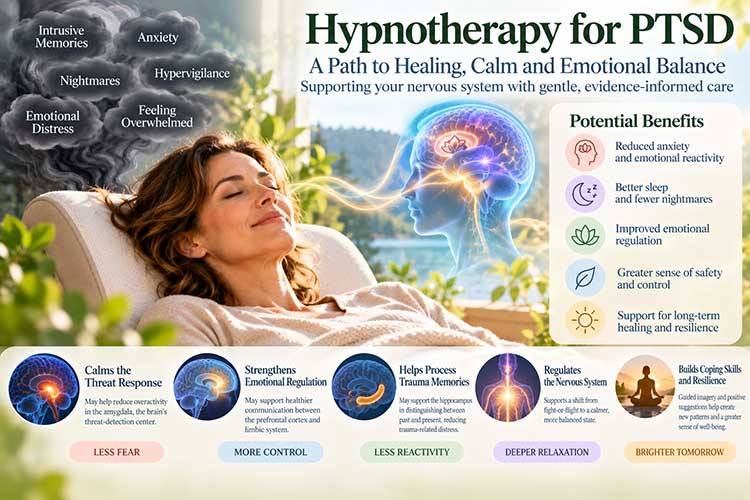
How clinical hypnosis may support emotional regulation, reduce trauma-related distress, and complement evidence-based PTSD treatment.
Traumatic experiences can leave lasting effects on the mind and body. Long after a frightening or overwhelming event has ended, the nervous system may continue responding as though danger is still present.
People living with post-traumatic stress disorder (PTSD) may experience intrusive memories, nightmares, heightened anxiety, sleep disturbances, emotional numbness, or an overwhelming sense of fear. Even ordinary sounds, smells, or situations can trigger intense reactions.
PTSD is not simply an inability to forget the past. It involves changes in how the brain processes threat, memory, attention, and emotional responses. Neuroplasticity—the nervous system’s ability to change through learning and experience—provides an important foundation for recovery.
What Happens in the Brain After Psychological Trauma?
1. The Amygdala: Threat Detection
The amygdala detects emotionally significant information, including potential threats. Some neuroimaging studies show increased responses to trauma-related stimuli in PTSD, contributing to hypervigilance and exaggerated startle reactions. A sound resembling a past accident may activate fear even in a safe environment.
2. The Prefrontal Cortex: Emotional Regulation
Prefrontal regions support attention, judgment, and emotional regulation. PTSD may involve altered communication between prefrontal networks and limbic structures, making it more difficult to regulate fear when reminders arise.
3. The Hippocampus: Memory and Context
The hippocampus helps organize memories and distinguish past from present. Altered hippocampal functioning may make traumatic reminders feel immediate, even when a person knows the event has ended.
4. The Autonomic Nervous System
Some people with PTSD experience persistent sympathetic arousal—rapid heartbeat, muscle tension, and heightened alertness. Others experience detachment or dissociation. Treatment aims to improve flexibility and regulation rather than force constant relaxation.
What Is Clinical Hypnotherapy?
Clinical hypnosis is a state characterized by focused attention, reduced awareness of competing stimuli, and increased responsiveness to suggestion. It is not unconsciousness or mind control. Patients generally remain aware and can communicate or stop at any time.
Sessions may include guided imagery, focused attention, relaxation, and carefully structured therapeutic suggestions. The goal is not to erase memories or require patients to relive trauma, but to practice more adaptive responses to thoughts, sensations, and emotions. Trauma-informed training and consent are essential.
How Does Hypnotherapy Work? A Scientific Explanation
1. Executive Control Network: Focused Attention
The executive control network, including the dorsolateral prefrontal cortex, supports attention and goal-directed thinking. Hypnotic guidance directs attention toward selected images or sensations while reducing distraction. This may help a patient rehearse a calmer response to tension or distress.
2. Salience Network: Identifying Important Information
The salience network includes the anterior insula and anterior cingulate cortex. It helps prioritize emotionally or physically significant information. Neuroimaging studies have reported altered connectivity between the dorsolateral prefrontal cortex and insula during hypnosis in highly hypnotizable individuals. This does not prove hypnosis reverses PTSD-related brain changes.
3. Default Mode Network: Self-Referential Thinking
The default mode network is involved in autobiographical memory and internally directed thought. Some studies observe changes in its activity or connectivity during hypnosis. These findings are variable, and there is no evidence that hypnosis reliably normalizes this network in PTSD.
4. Suggestion, Expectation, and Threat Perception
Perception is influenced by sensory input, prior learning, expectations, and context. Hypnotic suggestions can change some subjective experiences, including pain and emotional responses. Guided imagery may help patients practice grounding and calm responses. Hypnosis must never be used to recover or verify supposedly hidden traumatic memories, because suggestion can distort recollection.
Potential Benefits of Hypnotherapy for People With PTSD
Supporting Emotional Regulation
Hypnotherapy may help selected patients practice focused attention, calming imagery, and coping suggestions when emotions feel overwhelming. Reliable PTSD symptom improvement has not yet been established.
Reducing Stress and Physical Tension
Hypnotic relaxation may temporarily ease restlessness, muscle tension, and distressing bodily sensations. Relaxation alone is not sufficient treatment for PTSD.
Supporting Better Sleep
PTSD commonly involves insomnia, nightmares, and nighttime hyperarousal. Hypnosis-based relaxation may help some people settle before bed, but evidence specifically for PTSD-related sleep symptoms is limited. Established treatments such as cognitive behavioral therapy for insomnia remain important.
Developing Coping Skills
Suggestions can reinforce breathing awareness, grounding, and recognition of early stress signals. Patients may rehearse responding to bodily tension without escalating fear, alongside skills learned in psychotherapy.
Supporting Safety and Personal Control
Trauma-informed sessions emphasize choice, consent, predictability, and the patient’s ability to stop. This can create an opportunity to practice self-directed attention and a sense of control.
What Does Scientific Research Say About Hypnotherapy for PTSD?
Studies of hypnosis for PTSD remain relatively small and varied. Some report improvements in distress or sleep, but differences in methods and comparison groups limit conclusions.
The 2023 U.S. Department of Veterans Affairs/Department of Defense clinical practice guideline found insufficient evidence to recommend for or against hypnosis or self-hypnosis for PTSD. This does not prove ineffectiveness; it means strong evidence is lacking.
First-line treatments supported by stronger evidence include Prolonged Exposure (PE), Cognitive Processing Therapy (CPT), and Eye Movement Desensitization and Reprocessing (EMDR). Hypnotherapy should be considered complementary, not a substitute.
Why Trauma-Informed Hypnotherapy Is Important
Some people experience dissociation, depersonalization, derealization, or difficulty remaining oriented to the present. Intense inward focus may worsen distress for certain patients. A responsible approach includes screening, emotional safety, informed consent, and coordination with qualified mental health professionals. Practitioners should avoid forced memory exploration, unsupported recovered-memory claims, or promises to eliminate PTSD.
What Happens During a Hypnotherapy Session?
A session typically begins with discussion of goals and comfort. The practitioner may guide focused attention, imagery, relaxation, or coping suggestions. The patient remains able to communicate and stop. The session ends with a gradual return of attention to the surroundings. Trauma survivors should never be required to describe traumatic events in detail during a general relaxation session.
How Many Hypnotherapy Sessions Are Needed?
The number depends on the person’s goals, symptoms, response, and concurrent treatment. A few sessions may help some people learn relaxation or self-hypnosis, while others need more practice. There is no validated hypnotherapy schedule for PTSD. Progress should be measured through sleep, functioning, emotional stability, and coping; worsening symptoms warrant reassessment.
Dr. Tatyana’s Comprehensive Approach to Emotional Well-Being
At Family Acupuncture and Health in Kirkland, Washington, Dr. Tatyana combines medical knowledge with training in hypnotherapy and complementary wellness therapies. Her individualized approach may include relaxation-focused hypnotherapy, acupuncture for appropriate physical concerns, and supportive wellness strategies. These services do not replace specialized PTSD diagnosis or trauma-focused psychotherapy. Collaboration with qualified mental health clinicians is essential when PTSD symptoms are present.
Moving Toward Greater Emotional Balance
Trauma can affect memory, emotion, bodily sensation, and a person’s sense of safety. Neuroscience suggests hypnosis can influence attention and brain networks involved in self-referential thinking and cognitive control. More research is needed to determine its effectiveness for PTSD. For selected patients, carefully applied hypnotherapy may support relaxation and coping as part of broader care.
Healing from trauma is not about erasing the past. It is about developing the ability to live in the present with greater safety, stability, and confidence.
Contact Family Acupuncture and Health in Kirkland, Washington, to discuss whether relaxation-focused hypnotherapy is appropriate for your wellness goals.
Medical disclaimer: Hypnotherapy is not an established first-line PTSD treatment. Individuals with PTSD should seek care from appropriately licensed mental health professionals. Hypnosis should not be used to recover allegedly suppressed memories or replace evidence-based trauma-focused therapy.
Scientific References
VA/DoD Clinical Practice Guideline for PTSD (2023). https://www.healthquality.va.gov/HEALTHQUALITY/guidelines/MH/ptsd/
Jiang et al. (2017). Brain Activity and Functional Connectivity Associated With Hypnosis. Cerebral Cortex. https://pmc.ncbi.nlm.nih.gov/articles/PMC6248753/
Landry et al. (2017). Brain Correlates of Hypnosis: A Systematic Review and Meta-Analytic Exploration. Neuroscience &
Biobehavioral Reviews. https://pubmed.ncbi.nlm.nih.gov/28238944/
American Psychological Association. Hypnosis. https://www.apa.org/topics/psychotherapy/hypnosis